You are wrong if you think cross-functional teams fail because of “alignment”. They fail because of missing decision rights
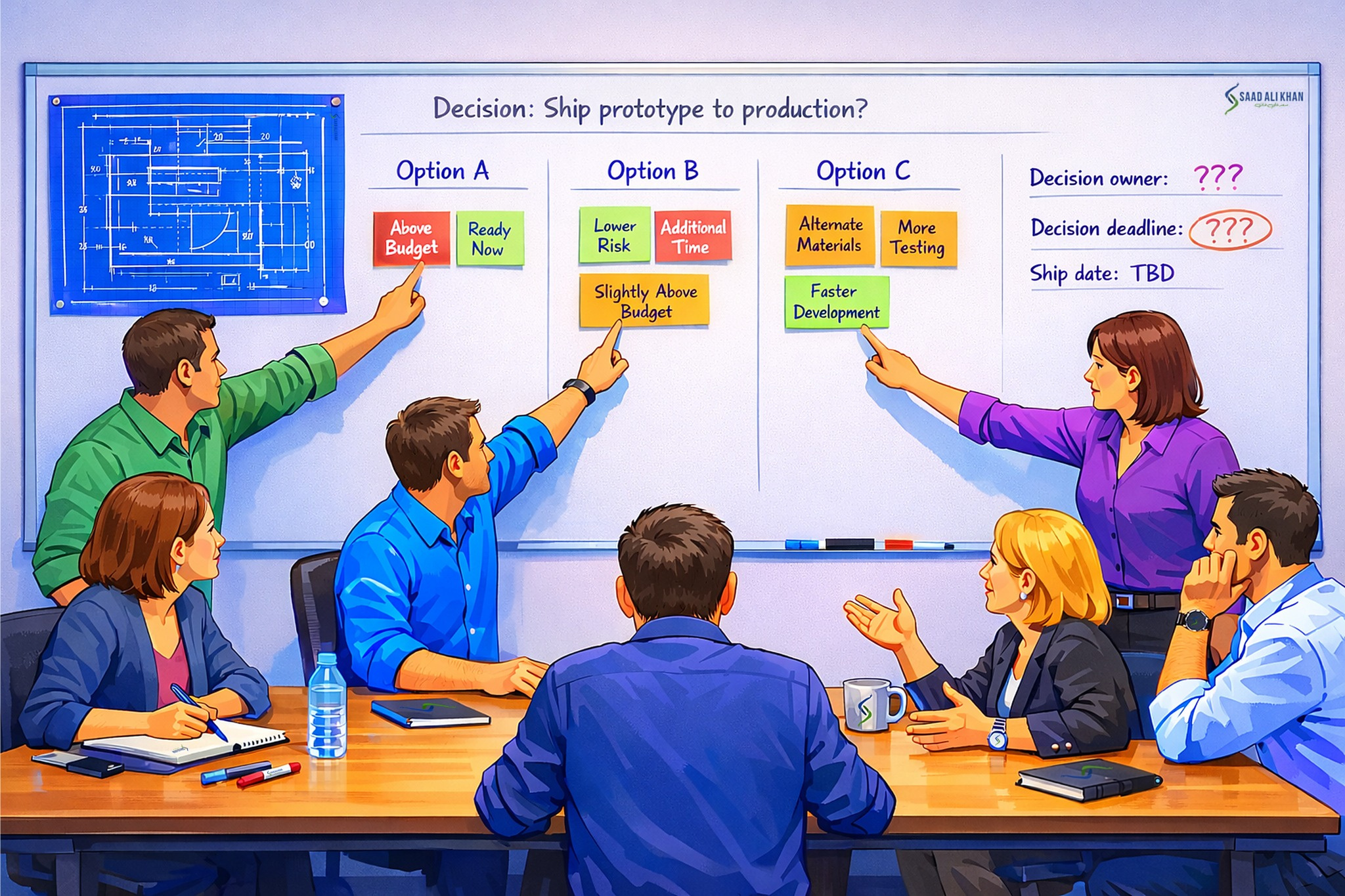
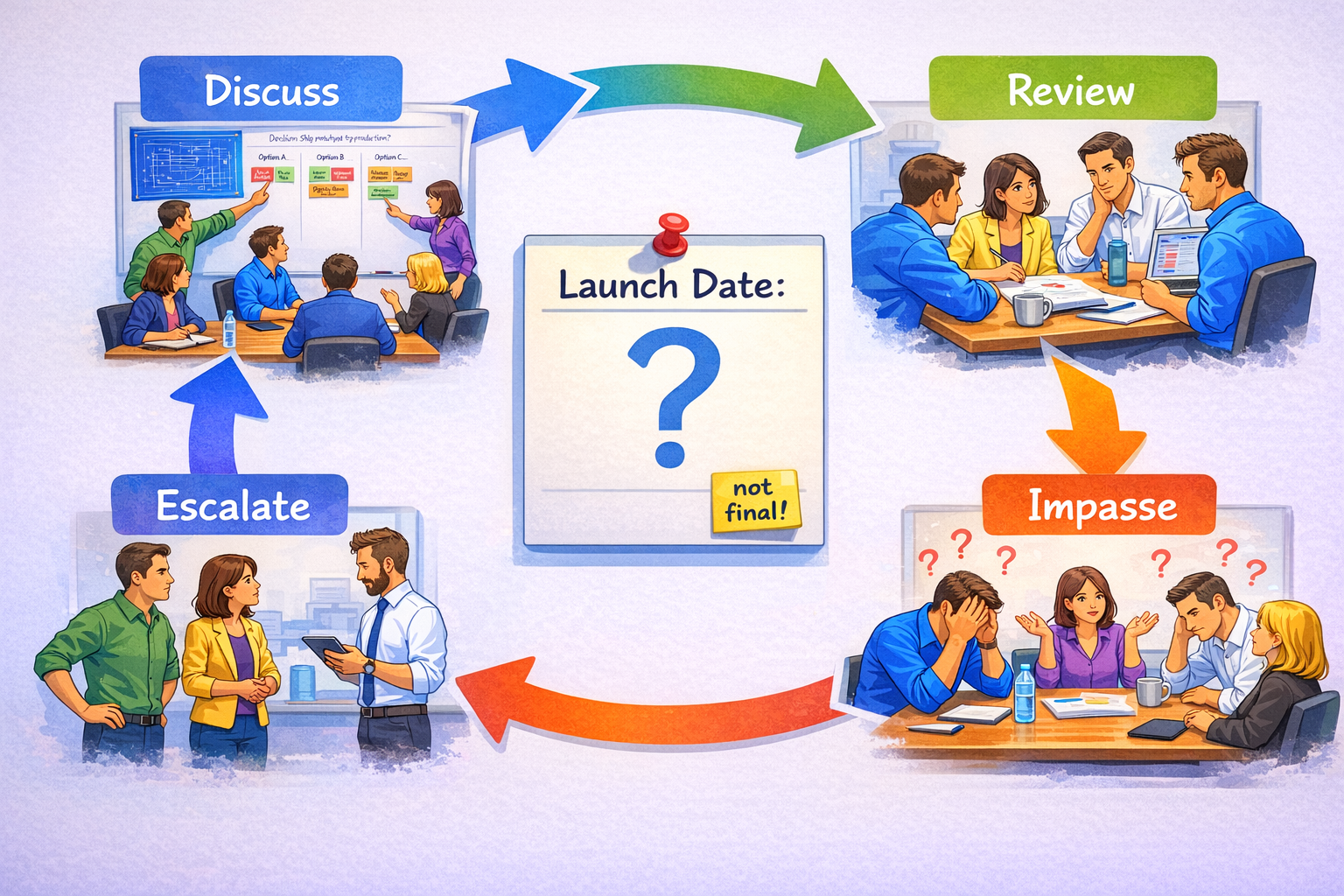
A launch meeting opens with a blunt question about the ship date. Someone asks, “Are we still shipping on the 15th?” Marketing says yes because campaigns are booked and channel plans are locked. Engineering says maybe because one dependency still looks shaky. Sales pushes earlier because a deal depends on the launch. Finance asks for a hard number because spend approvals need precision.
Operations pushes for a quality bar because support will feel the pain. Every function protects a real constraint and a real risk. The room stays polite and the decision still stays open. The operating model never named a decision owner for this call. The meeting ends with “let’s align offline” and nobody logs a final decision.
The same thread returns on Thursday with a new wrapper. A manager floats a date move “for now” to avoid conflict. Scope expands quietly because nobody owns the scope boundary. Another reviewer gets added because the approval chain has no stop rule. People keep working while they keep options open. Teams build multiple versions because the final call feels reversible. Two weeks later, the calendar shows more meetings and fewer closed decisions.
Your cross functional team is not stuck because people cannot communicate. Your cross functional team is stuck because decision rights are missing. Missing decision rights keep choices soft and outcomes negotiable. Managers run coordination without managerial authority at key boundaries. Teams pay the same debate tax each week because nobody closes.
Decision paralysis shows up far more than teams admit. Teams use the same phrases: “one more review” and “we need alignment.” The work moves, but it moves sideways because nobody owns closure. The cost rises through rework, churn, and delayed commitments. HBR found 75% of cross functional teams are dysfunctional. The same article describes a $100 million IT effort that drifted for years.
Cross functional drag hits marketing teams hard because they depend on many functions. Meetings grow because stakeholder influence replaces clear decision authority. Review cycles repeat because nobody owns a firm deadline. Gartner found 84% report high collaboration drag in cross functional work. Gartner links drag to too many meetings and too much feedback. Gartner also points to unclear decision making authority as a core driver.
High drag hurts revenue because execution slows and learning cycles shrink. Growth work depends on speed, focus, and stable decisions. Open decisions push downstream work into last minute scrambles. Gartner says high drag makes firms 37% less likely to exceed revenue goals. The same pattern blocks profitability because teams spend time coordinating instead of delivering.
High drag also creates a people cost that teams underestimate. Employees feel busy while progress stays unclear and unstable. The system trains people to wait because decisions reverse without rules. Gartner says high drag links to burnout and planned exits. That cost shows up as disengagement, not always visible conflict.
Repeated debate usually signals missing decision rights, not weak communication. Teams talk, but the operating cadence never assigns final authority. Meetings turn into negotiation because nobody can close the call. Managers schedule more syncs because the decision pipeline stays clogged. Delivery slips even with strong talent because the decision stays open.
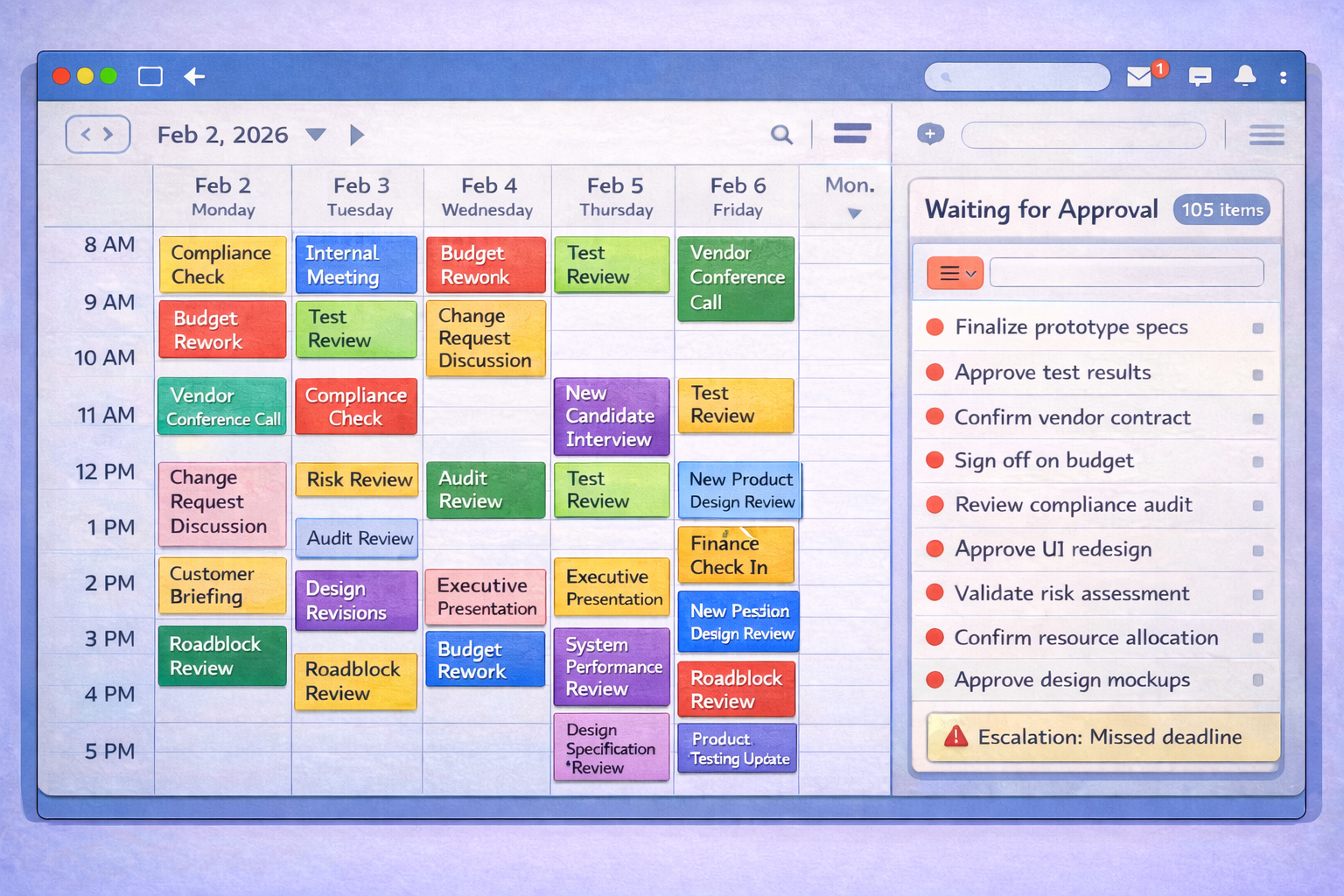
Managers can spot the pattern once they track decision ownership. Dates slide because nobody sets a decision deadline with a named owner. Work sits at “90% done” because approvals have no accountable decider. People cannot find the final call because nobody records it. Escalations arrive late because leaders hear issues after deadlines break. Meetings multiply while output stays flat because debate has no closure.
Modern work conditions make closure harder because attention stays fragmented. Teams bounce across chat, meetings, docs, and email all day. Decision context spreads across channels and vanishes quickly. Microsoft reports workers spend 57% of time communicating and 43% creating. Microsoft also reports 62% struggle to find information they need. Search time rises when decisions lack a single decision record.
Decision owners need focus time to review inputs and decide. Meeting heavy calendars cut that focus time into small pieces. Microsoft reports 68% lack enough uninterrupted focus time at work. Owners defer decisions because they cannot process inputs properly. Teams pull decisions into meetings because meetings feel safer. Meetings rarely close decisions when authority stays shared and unclear. Decision rights restore closure without adding more meetings.
Notifications keep breaking attention, even when calendars look open. People pay a reset cost each time they return to a decision. Microsoft reports employees get interrupted every two minutes during core hours. Teams need a decision system that survives interruptions. Decision rights create closure through owners, deadlines, and a durable record. Reversal rules keep flexibility without reopening by preference.
Leaders often treat this as a communication problem and push for “alignment.” Leaders add meetings and add stakeholders and ask for longer updates. Managers spend time presenting instead of making hard calls. The organization increases activity while decision authority stays unclear.
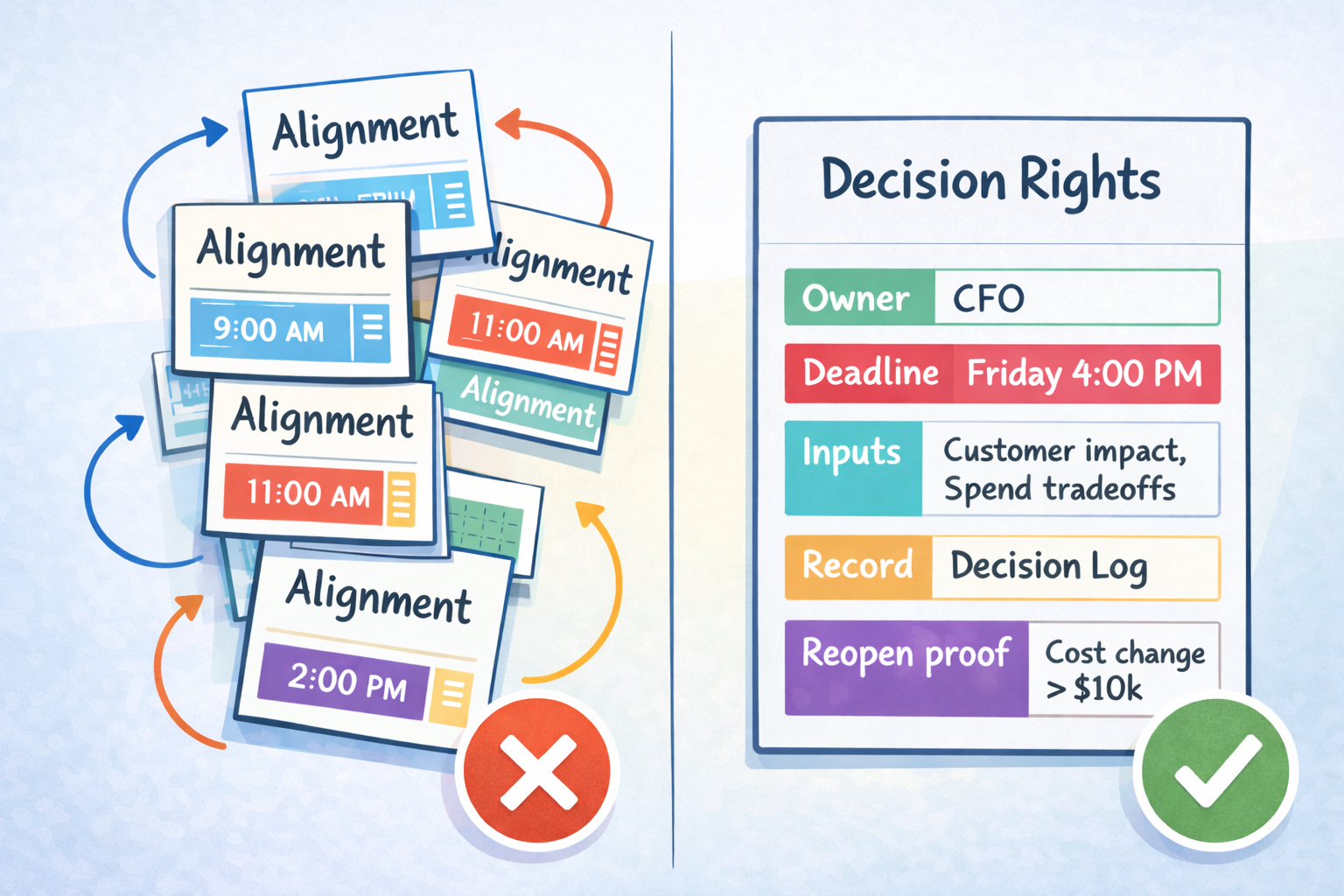
Decision rights fix the real issue because they define authority and accountability. Decision rights define who decides and when the decision closes. Decision rights define which inputs matter and who must provide them. Decision rights define where the decision record lives so teams can find it. Decision rights define what evidence can reopen the decision later. Decision rights answer five questions that protect delivery and reduce churn.
- Who decides and owns the final call for this decision?
- What decision deadline forces closure and ends debate?
- Which inputs matter and who must provide them on time?
- Where do you record the decision so everyone can find it?
- What proof can reopen the decision and change direction later?
Teams feel the difference once they answer these questions clearly. People stop building parallel plans because decisions stop wobbling. Managers stop chasing silent approvals because authority becomes explicit. Execution moves faster because the decision record removes ambiguity. Stakeholders focus on inputs instead of influence tactics. The team spends time building and shipping, not relitigating decisions.
Decision rights do not mean consensus or endless alignment meetings. Decision rights mean input without veto, except for real constraints. Teams separate execution ownership from decision ownership to reduce friction. One person can run delivery while another owns the boundary call. Authority works when one person can decide and document the decision. That clarity reduces stakeholder sprawl because people stop fighting for control.
Cross functional work breaks at a small set of decision boundaries. These boundaries change what everyone does next, so conflict shows up. Teams argue about the whole project when boundaries stay vague. Managers regain control when boundaries get clear owners and deadlines. The same boundaries repeat across industries because they control delivery risk. These boundaries deserve explicit decision rights, not informal influence.
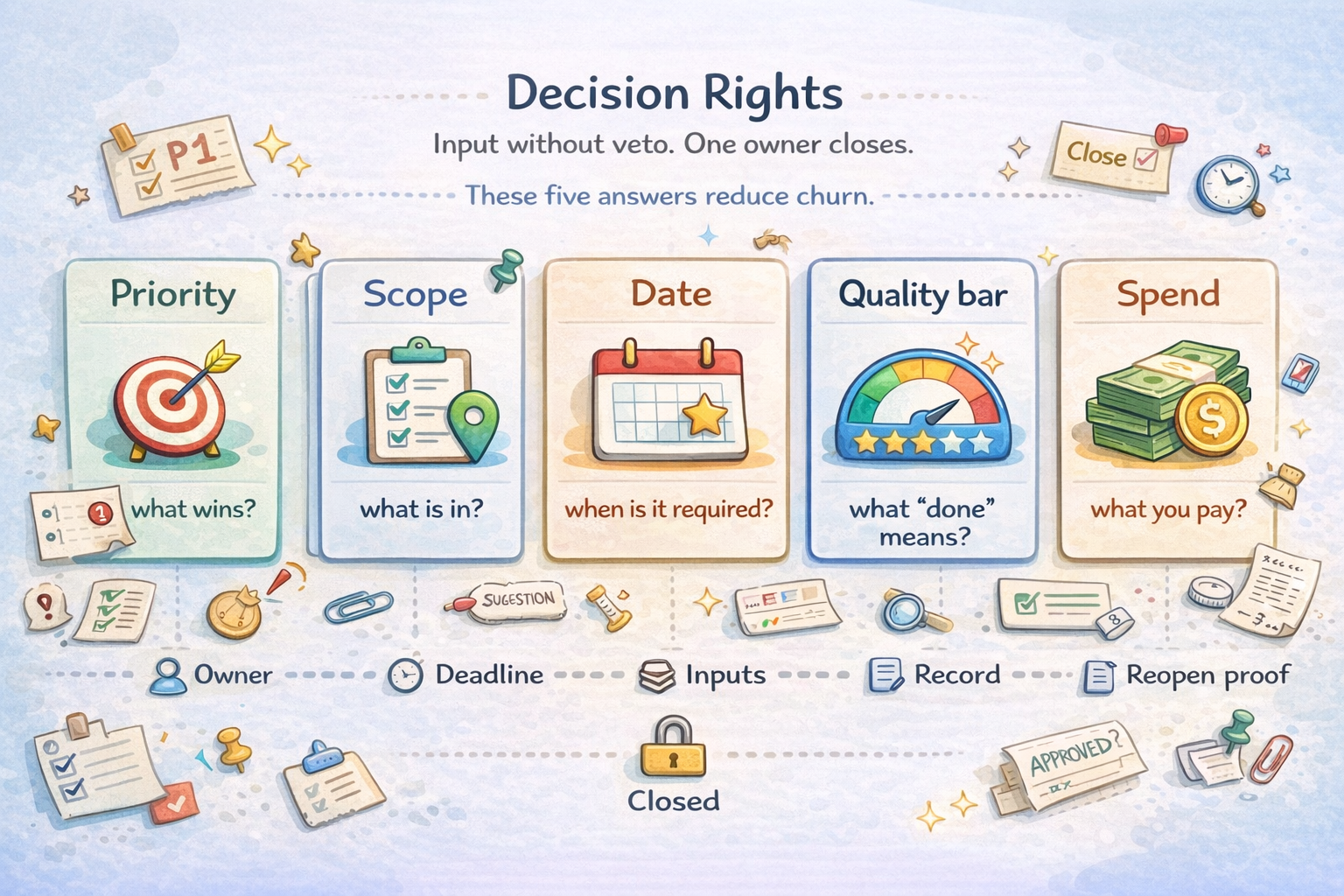
- Priority decides what wins when initiatives collide.
- Scope defines what stays in and what stays out.
- Date sets the ship moment and forces real choices.
- Quality bar defines what “done” means in practice.
- Spend sets what you pay for speed, reliability, and growth.
Unclear boundaries invite loops because each function protects its own risk. Priority breaks when a new request jumps the line and nobody drops work. Scope breaks when “one more thing” piles up and nobody owns “no.” Date breaks when shipping becomes a suggestion instead of a committed decision. Quality breaks when teams rewrite standards after release and call it alignment. Spend breaks when teams renegotiate budgets monthly because sponsorship stays vague.
A common loop shows up around date and scope decisions. A team agrees to “ship Friday” and “keep the must haves.” A new risk appears midweek and the debate restarts. Nobody owns the date decision, so nobody closes it. Scope keeps expanding because nobody owns the scope boundary. The same meeting returns with the same arguments and new people.
Hidden veto power keeps these loops alive without open conflict. People say “I am not comfortable yet” without naming a hard constraint. People ask for “leadership alignment” without naming the decider and deadline. Review lists keep growing because nobody owns the approval boundary. Managers treat these patterns as teamwork issues and add more meetings. The real fix sits in decision authority and decision records, not more discussion.
Teams keep roles clean with a simple decision role split. One person frames the problem and proposes a path with evidence. One person owns final authority and closes by a defined time. A small set of roles can block only for hard constraints. Everyone else provides time bound input that closes before the deadline. Delivery owners execute after the call and stop reopening the boundary. This keeps stakeholder input real while keeping decision authority clean.
A short constraint list protects real risk without creating silent vetoes. Constraint owners need deadlines for their input, not open ended caution. Advice still matters, but advice does not block the call. Managers protect fairness by applying the same rules to all functions. The system builds trust because people see consistent decision discipline.
The Decision Documents
Two lightweight artifacts make decision rights operational for managers. A Decision Rights Map makes authority visible at key boundaries. A Decision Log makes the decision durable across meetings and channels. Managers use both to reduce decision latency and meeting load. Teams also use both to reduce rework and repeated debates. Small artifacts beat big governance decks because teams keep using them.
A Decision Rights Map is a short list of decisions that keep repeating. Each decision needs a clear statement that resists twisting in debate. Each decision needs one owner and one deadline with a clock time. The map lists required inputs, kept small and specific. The map lists an escalation path so owners do not stall. The map lists reversal proof so reopenings follow evidence and rules.
The map also names where the decision record will live. Teams lose decisions when records scatter across chats and notes. Managers reduce politics when the record stays visible and stable. Input lists must stay short or owners drown in opinions. Escalation rules must stay clear or escalations arrive too late. Reversal proof must stay objective or preference keeps reopening decisions. A good map reads like a management operating rule, not a manifesto.
Small scope works best because teams maintain what teams can use. Ten recurring decisions from the last month give enough coverage. Teams lose discipline when maps try to cover every decision. Painful decisions drive adoption because teams feel relief quickly.
The Decision Log creates a single source of truth for decisions. Meeting notes do not stop repeats because notes stay scattered. A log stops repeats because it answers “what did we decide” fast. Decisions need a written record to survive new stakeholders. Teams should log decisions within 24 hours to keep context. The log reduces decision churn because reopening requires evidence.
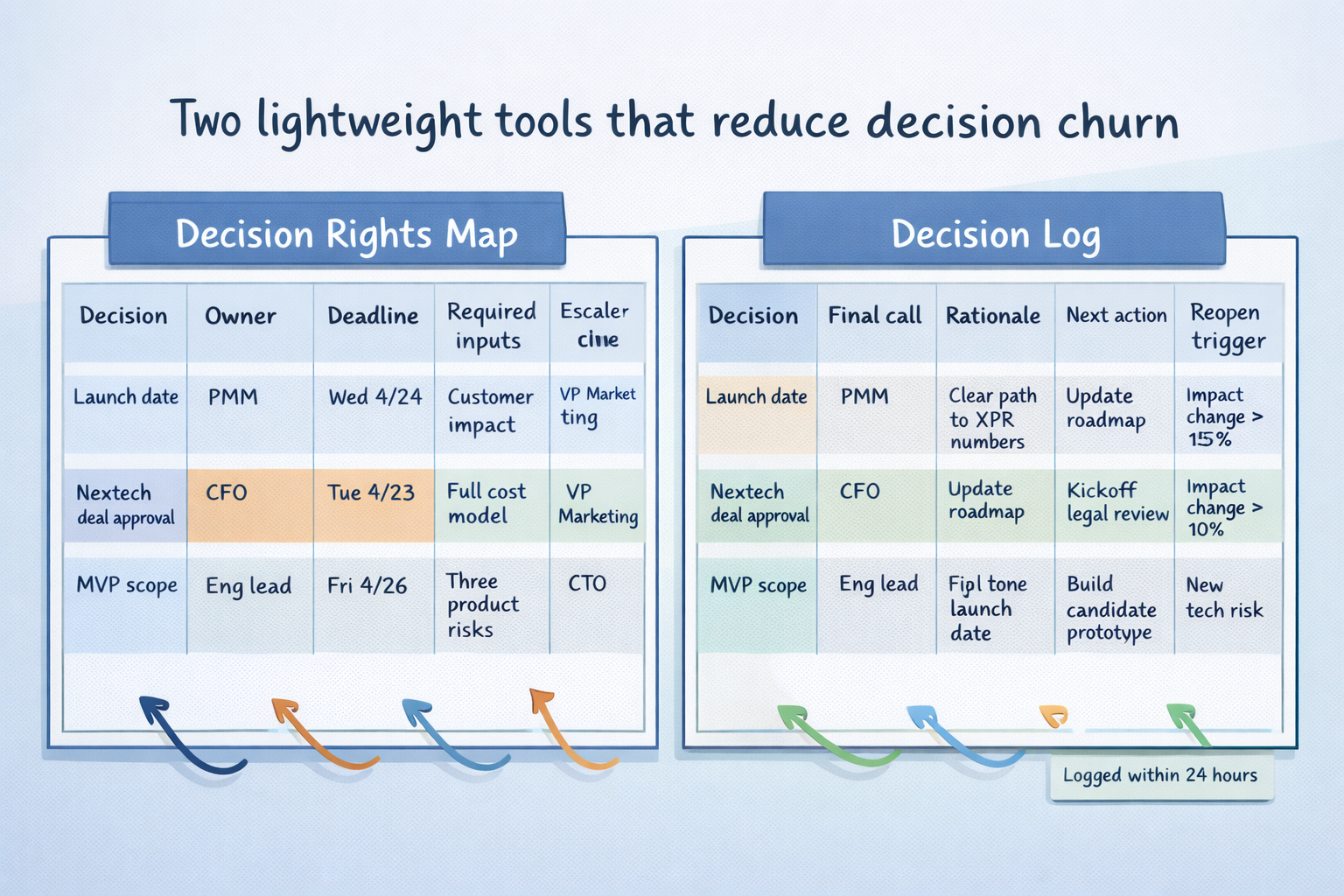
A tight decision statement keeps the log usable and clear. A short rationale ties to evidence, constraints, and customer impact. Next actions include owners and due dates so execution starts immediately. Reversal proof defines what can reopen the decision later. Teams link the log back to the original discussion thread. One question guides reopen requests: what changed that meets the reversal rule.
Decision research supports this approach because clean process improves speed and quality. Slow decisions invite drift, rework, and constant stakeholder management. Teams lose learning cycles when debate replaces shipping and measurement. Deadlines force stakeholders to bring input on time and clearly. McKinsey reports fast decision makers are twice as likely to decide well. Decision rights cut cycles without cutting standards or accountability.
Quality stays high when decisions close and stay stable long enough. Teams protect fairness through objective reversal rules and visible records. Managers protect authority through owners and deadlines that hold. Stakeholders feel respected through clear input windows and constraint rules. Rework drops because people stop building backup plans for uncertainty. The system rewards execution because decisions stop returning as repeats.
Pushback shows up because people fear exclusion and blame. Managers reduce that fear by keeping rules consistent and visible. Input windows keep contribution real without turning into veto power. Escalation paths protect owners who need support on hard calls. Reversal proof protects stakeholders who fear irreversible mistakes. A decision record protects everyone because it shows the call and rationale.
The 7 Day Plan
A seven day install plan fits busy teams with limited bandwidth. The plan uses existing meetings and existing work channels. Each day adds one management control that strengthens decision discipline. Teams should see fewer repeated debates by the week’s end. Managers should see clearer accountability at priority, scope, date, quality, and spend. The plan aims for usable governance, not perfect governance.
- On day one, list the ten recurring decisions that caused friction last month.
- On day two, assign one decision owner for each decision on the list.
- On day three, add deadlines and escalation rules and reversal rules for decisions.
- On day four, start the log and log decisions within 24 hours.
- On day five, stop decision talk without an owner and deadline.
- On day six, run a ten minute decision review with strict focus.
- On day seven, measure repeated debates and late escalations across teams.
Day One: Pull the decisions from real friction
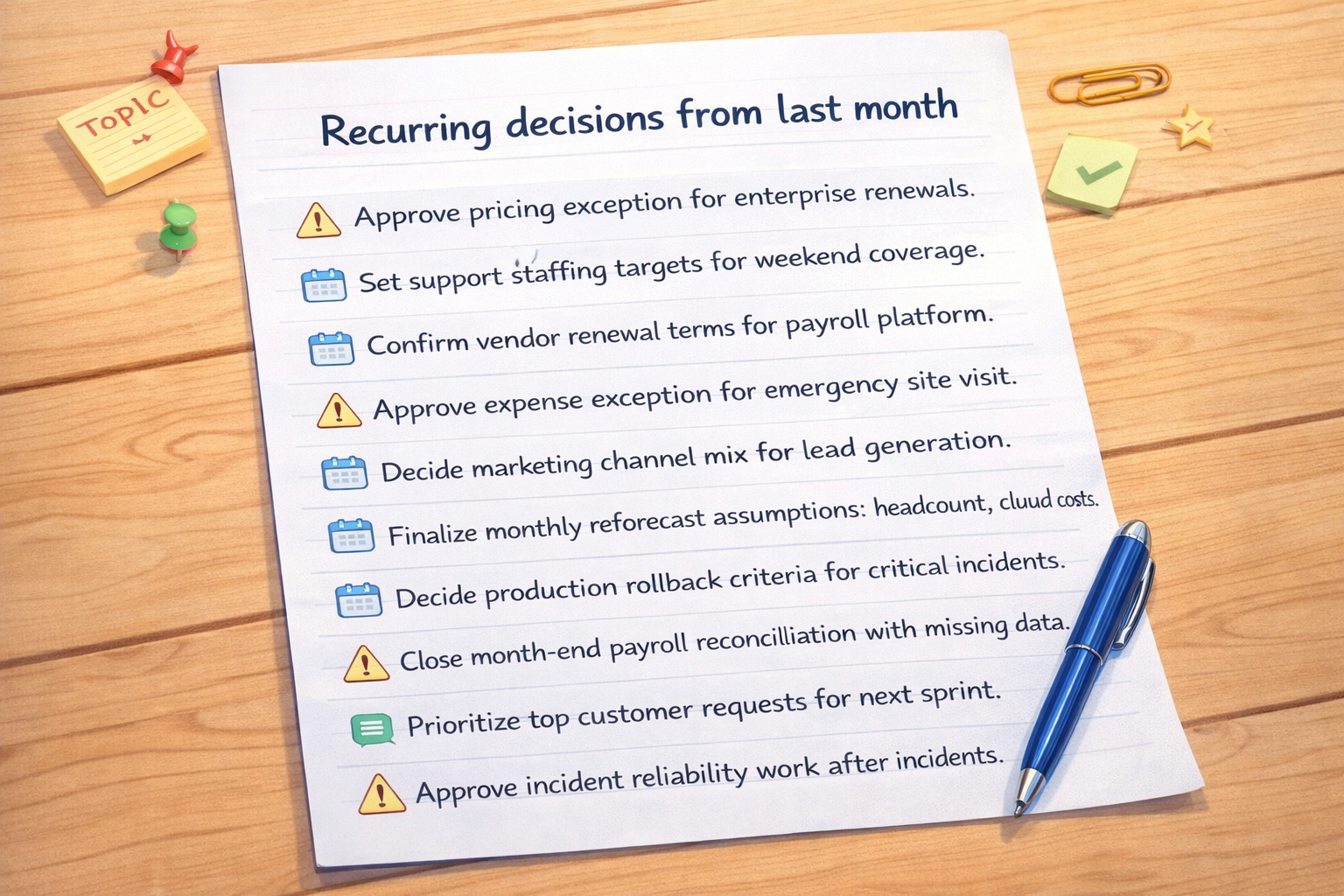
Day One starts with the last month, not ideals or org charts. Meeting titles, message threads, and escalations expose recurring decisions. Decision statements work better than themes because they force clarity. Teams write “set top three priorities for Q2” instead of “roadmap alignment.” Teams write “lock ship date for release X” instead of “launch readiness.” Managers build a decision list owners can actually close.
A short working session beats a presentation because teams need real examples. Each function brings one decision that wasted time last month. Each function also names the moment where the decision stalled. People describe feelings like “messy,” so managers push for the exact call. Decisions that change next week’s work belong on the list. Opinions that do not change action stay out of week one.
Day One works best when teams treat it like operational triage. Teams rank decisions by repeat frequency and delivery impact. Five decisions provide focus and visible proof inside one week. A visible list of the other five reduces anxiety and politics. Managers keep the tone neutral and practical to avoid defensiveness. Clarity improves faster when people feel safe naming friction.
Teams use the map to make decision ownership visible in minutes. The layout forces a decider, a deadline, and required inputs. It also captures escalation timing and the evidence needed to reopen. Download Day 1 Decision Rights Map as PDF from here.. Fill it during a live discussion while people still share context. Keep the first version small so managers enforce it without friction. Use the same map in reviews so the team stops restarting debates.
Day Two: Assign one owner per decision and make it real
Owner assignment should follow accountability, not meeting volume or loud voices. Date decisions sit with the role accountable for shipping outcomes. Spend decisions sit with the role accountable for budget authority. Quality bar decisions sit with the role accountable for customer impact. Scope decisions sit with the role that can say “no” credibly. Authority works when owners can decide and accept consequences.
Hesitation shows up fast because people fear scrutiny after a hard call. Managers reduce that fear through clear inputs and clear escalation rules. Reversal proof also reduces fear because evidence can reopen decisions. Input windows protect stakeholder respect without granting veto power. Decision authority becomes less personal because rules carry the load. Teams argue less when the process feels consistent and fair.
Co ownership often recreates the loop because nobody holds final authority. Two leaders can care deeply and still name one owner. Input roles can stay broad while decision ownership stays narrow. Owners should not inherit extra execution workload by default. Owners close the boundary call, document it, and move. Teams move faster when one name sits next to the decision.
Ownership needs confirmation where the work happens, not in hidden docs. Teams post the decision, owner, and deadline in the active thread. Owners confirm in that same thread so authority sits in writing. Managers point people back to the owner when side debates start. Public confirmation reduces backchannels because the decision owner is visible. Escalations drop because input flows to the right place.
Owner confirmation removes the quiet question of who holds authority. A short note in the working thread prevents side approvals and whispers. It sets the decision deadline and names the input window up front. Download Day 2 Decision Owner Confirmation as PDF from here.. Post it where the debate happens so stakeholders see the boundary. Managers should redirect questions to the owner instead of reopening meetings. That discipline builds trust because closure feels consistent across functions.
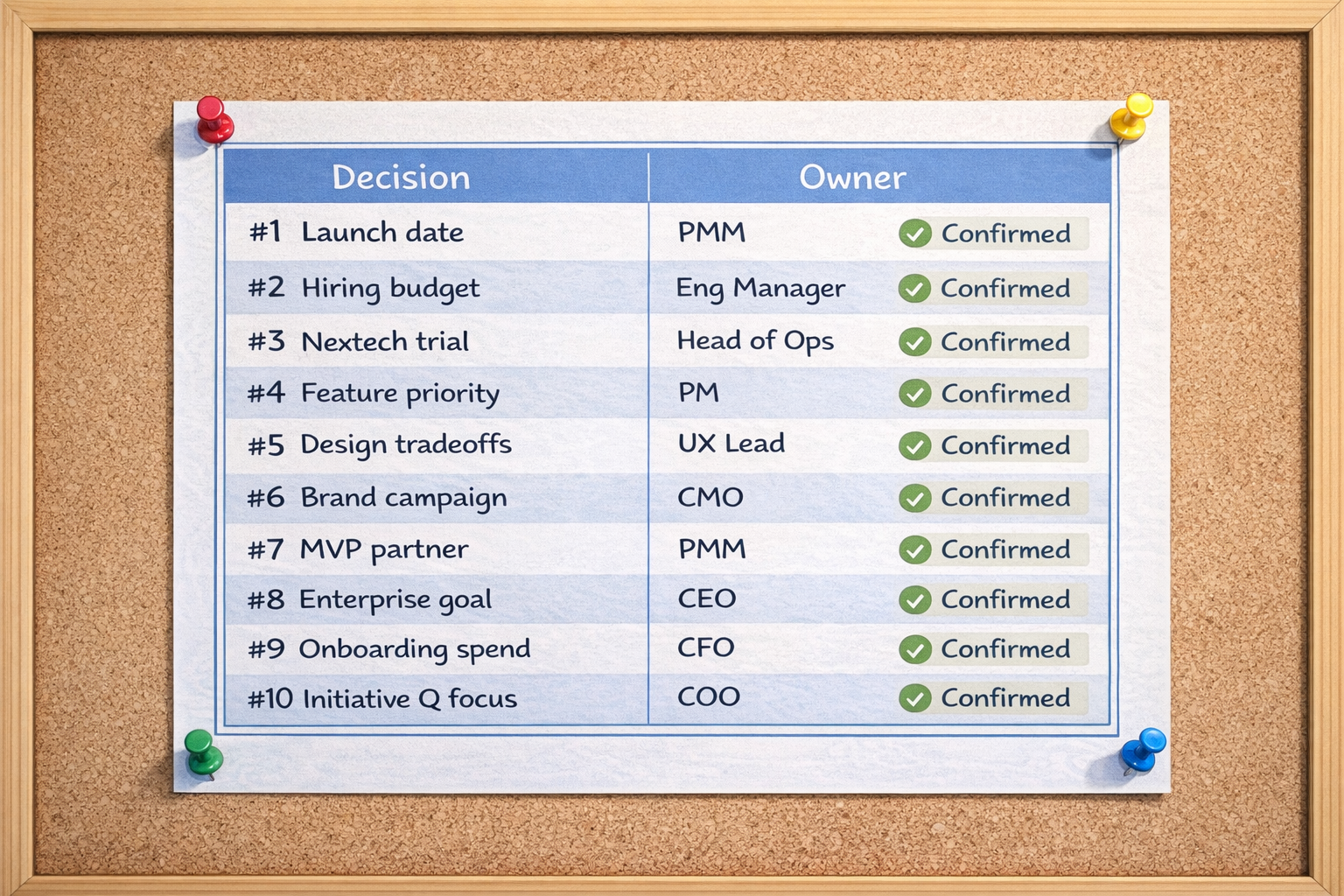
Day Three: Add deadlines, escalation, and reversal proof
Day Three makes decision rights hold under normal pressure. Decision deadlines need clock times, not vague “end of day.” Input deadlines need to land before the decision time. Owners need space to review inputs and close cleanly. Escalation paths need a tie breaker and a time. Leaders help most when they step in before deadlines collapse.
Input lists must stay small or decision speed collapses. People add reviewers to feel safe and avoid blame. Safety without closure becomes delay and rework. Managers apply one standard: required input must change the call. Optional input can arrive, but optional input cannot move the deadline. Owners gain authority when managers enforce that rule consistently.
Reversal proof must read like a trigger, not a feeling. Numbers work well when teams can measure them reliably. Events work well when numbers do not fit the decision. Vague proof invites influence games because nobody can test it. Evidence based proof keeps flexibility without constant reopening. Managers write reversal proof early to avoid later negotiation.
Late concerns still appear because people remember risks after deadlines. Teams treat late concerns consistently to protect trust. Evidence that meets the reversal rule should reopen quickly. Concerns that miss the rule should get logged for later review. Owners keep the call closed when the evidence stays unchanged. Stakeholders adapt when deadlines keep meaning something.
A one line rule keeps deadlines and escalation clear under pressure. Teams paste it into the thread that carries the decision discussion. The rule should name the decider, input cutoff, and reversal proof. Download Day 3 Decision Rule Text as PDF from here.. Use it on date, scope, spend, and quality calls that repeat. Short wording reduces room for interpretation and limits backchannel vetoes. Managers enforce faster because the rule reads the same for everyone.
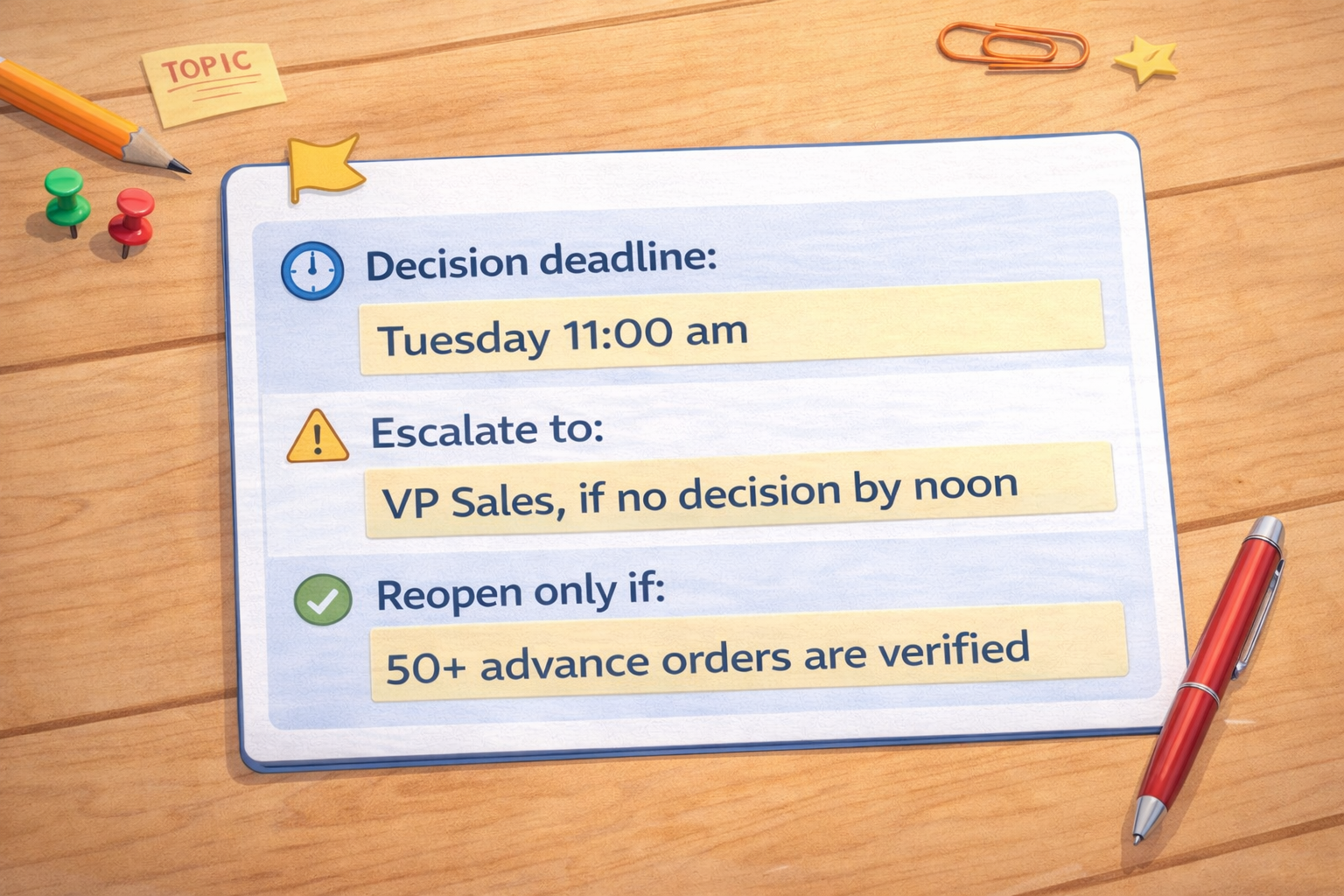
Day Four: Start the log and log decisions within 24 hours
Day Four creates a durable decision register for the team. One shared home matters more than the tool choice. Logs should live close to daily work channels and workflows. Decisions should get logged within 24 hours to keep context. A fast log reduces rumors because the decision becomes visible quickly. Teams reduce repeated questions because the record stays easy to find.
Decision statements should stay tight to reduce interpretation fights. Rationales should tie to evidence, constraints, and customer impact. Vague rationales create politics because people assume motives. Specific rationales protect owners because the record shows intent. Clear rationales also reduce future renegotiation attempts. Stakeholders accept decisions more often when the “why” stays visible.
Next actions need owners and due dates to start execution. Links back to the original debate thread keep closure visible. Owners confirm the log entry so accountability stays clear. Managers treat logging as operational hygiene, not paperwork. Teams keep the log small and consistent to protect adoption. A clean log turns meeting time into delivery time.
The log template makes the decision record easy to keep current. Teams capture the call, rationale, next action, and reversal trigger. A consistent format reduces arguments about what the decision really was. Download Day 4 Decision Log as PDF from here.. Log the entry within a day so context does not drift. Link the record back to the thread so new stakeholders catch up. Reopen only when evidence meets the trigger, not when opinions change.
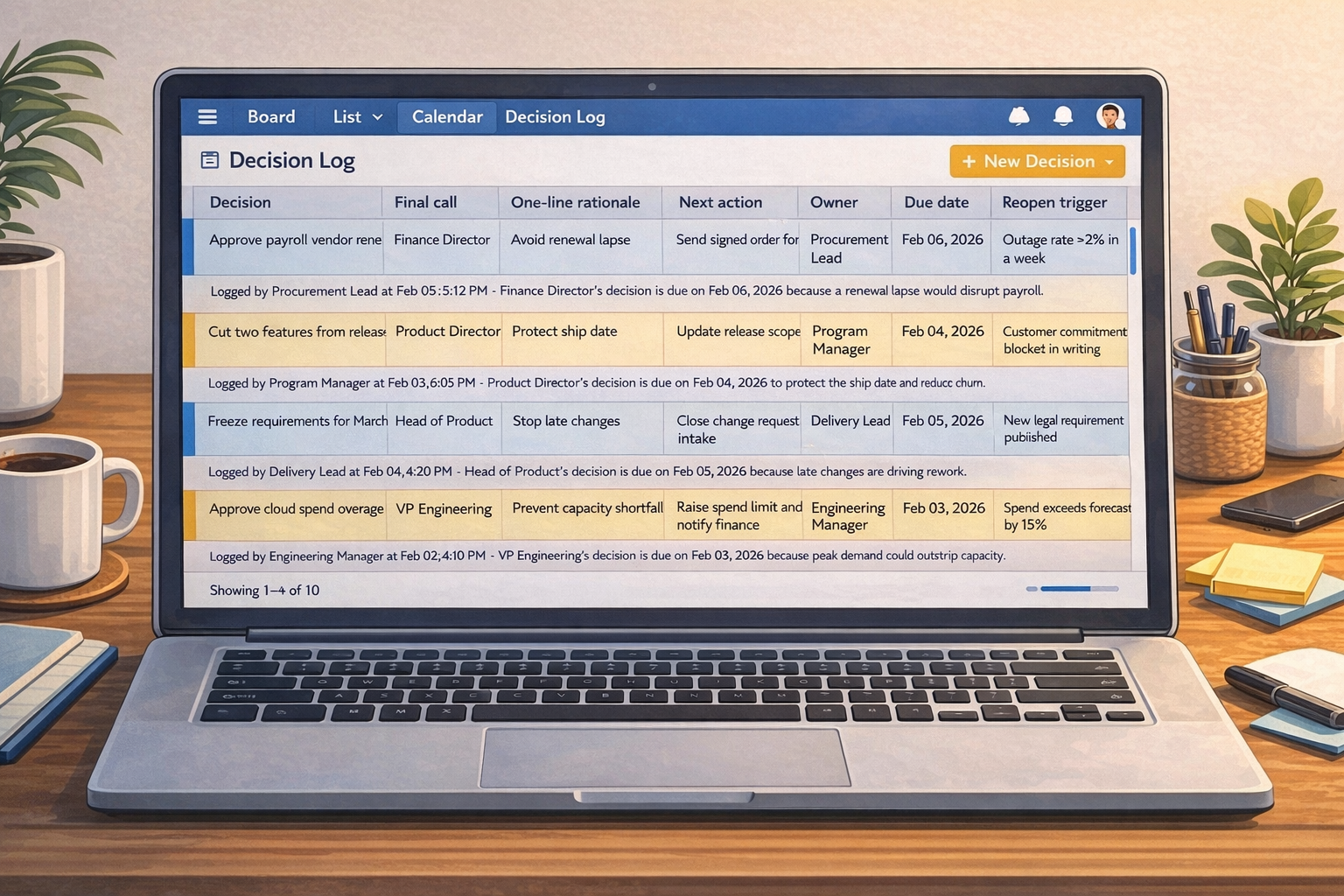
Day Five: Stop decision talk without an owner and deadline
Day Five changes meeting behavior without adding new meetings. Managers ask two questions when debate starts in a room. One question asks for the decision owner. One question asks for the decision deadline. The questions stay calm because the goal is closure. Teams learn quickly when meetings produce decisions, not recycled discussion.
Decision talk without an owner and deadline creates churn and confusion. Teams should name the decision in plain words in the moment. Teams assign an owner and a deadline during the meeting. Teams define required inputs and set an input deadline. Owners close the call by the deadline and document it. Meetings end earlier because more debate rarely changes the call.
Side conversations continue early because habits do not vanish quickly. Managers redirect without conflict by pointing to the owner and record. Managers ask what new evidence meets the reversal rule. Stakeholders with evidence get a fair reopen process. Stakeholders without evidence stop getting decision changes through persistence. The system becomes predictable, and predictability reduces politics.
A meeting opener sets authority, goal, and timebox before debate starts. It names the decision, the decider, and the deadline in plain words. That framing prevents status drift and keeps stakeholder input time bound. Download Day 5 Decision Meeting Card as PDF from here.. Use it for meetings that repeatedly end with “let’s align offline.” Managers can stop the meeting once the owner, inputs, and deadline exist. Teams leave with a decision path instead of another follow up loop.

Day Six: Run a ten minute decision review with strict focus
Day Six keeps decision discipline from fading after week one. Ten minutes works because it forces focus and avoids new bureaucracy. Reviews cover decisions made, decisions open, and missed deadlines. Reviews skip general status updates because other rhythms already cover status. Managers focus on decision mechanics, not personalities. Teams gain trust when the system improves each week.
Missed deadlines need a practical diagnosis, not a public inquest. Input lists often grow too large for available time. Inputs often arrive late, leaving owners no thinking window. Authority sometimes stays unclear at the boundary being decided. Escalation paths sometimes activate too late to help. Managers ask what blocked closure and adjust the system.
Rule adjustments should stay small and specific for fast improvement. Smaller input lists reduce decision latency and reduce meeting churn. Earlier input deadlines protect owner focus time and reduce late blockers. Clear escalation timing prevents last minute chaos and surprise leadership escalations. Earlier decision deadlines help because downstream work locks fast. Teams stabilize when rules evolve through evidence, not opinions.
A short review agenda keeps the weekly check focused on decisions only. The agenda tracks open decisions, missed deadlines, and escalation timing. Teams can adjust inputs and reversal rules without turning it personal. Download Day 6 Weekly Decision Review as PDF from here.. Run it in ten minutes so it stays a management habit. Capture one fix per week and apply it to the top repeating boundary. Consistency matters because teams trust rules that improve in small steps.
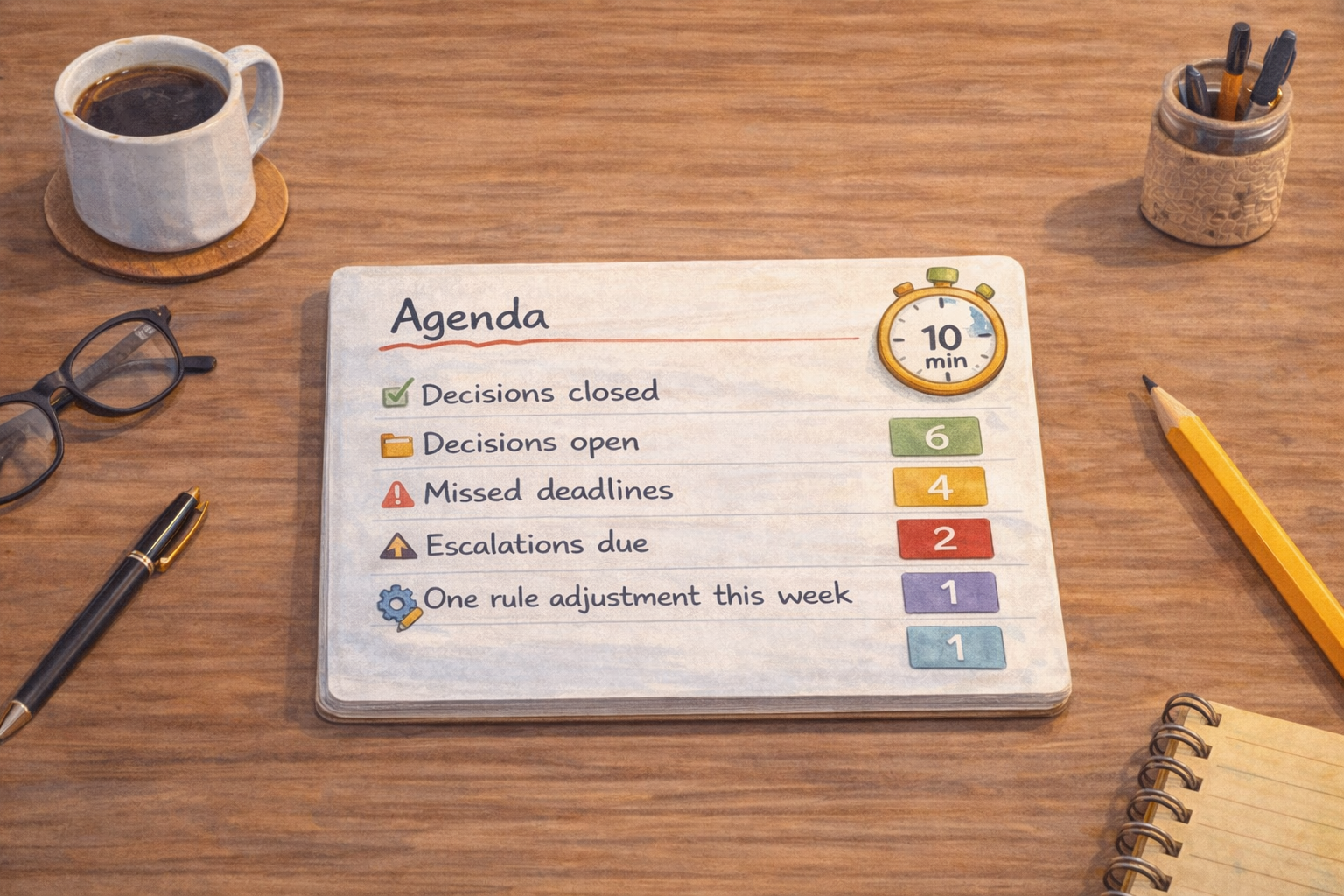
Day Seven: Measure repeated debates and late escalations
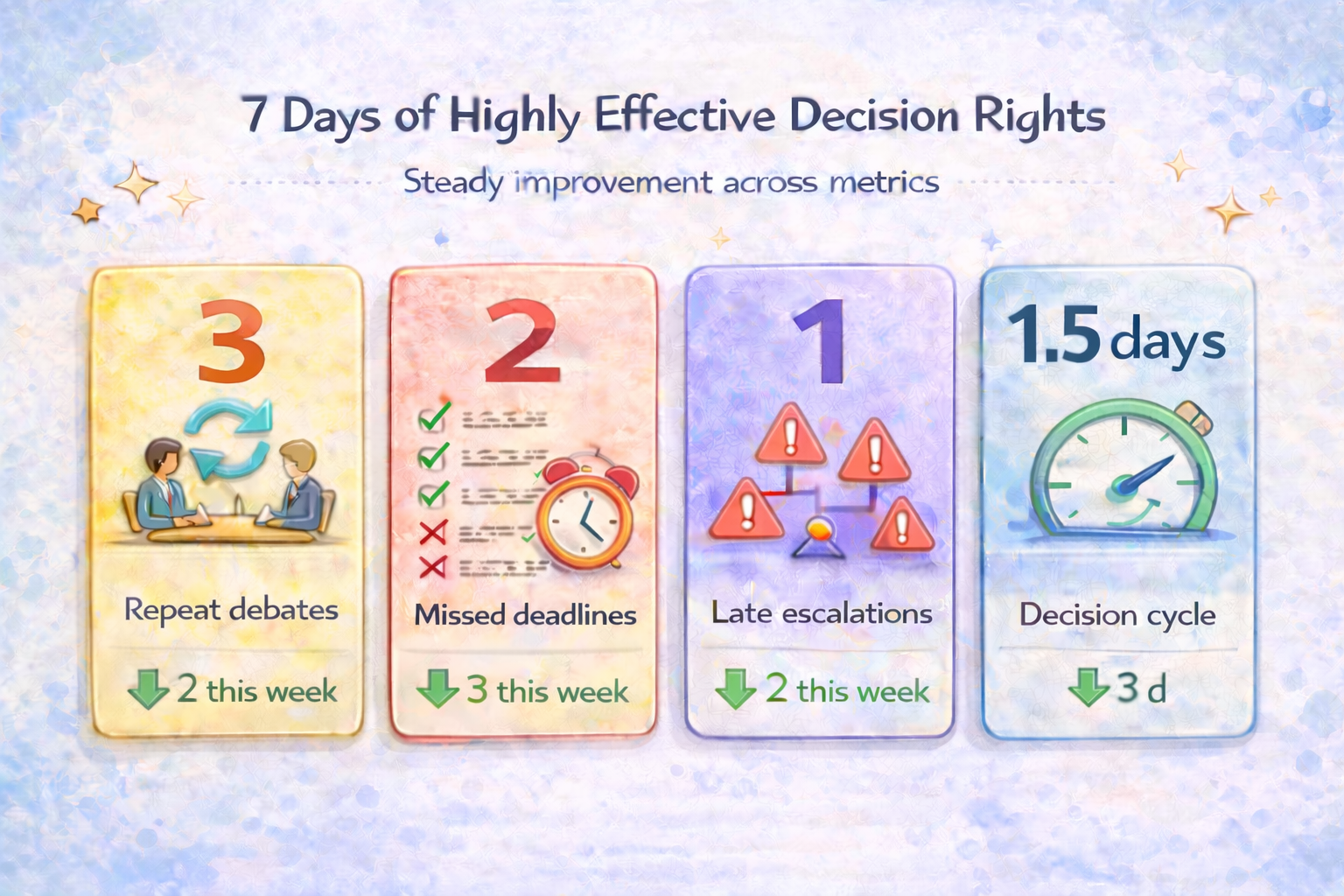
Day Seven proves value through simple decision operations metrics. Teams count repeated debates because repeats show weak ownership or weak deadlines. Teams count late escalations because late escalations show broken escalation paths. Teams count missed deadlines because misses show poor decision discipline. Teams track decision cycle time from first mention to logged closure. Managers use these signals to tighten decision rights where friction clusters.
Light metrics work better than heavy dashboards for sustained use. Weekly updates fit normal management cadence and review rhythms. Patterns matter more than single week spikes for diagnosing system issues. Clusters often point to the same boundary decision repeating. Date decisions often need a quarter owner to reduce renegotiation. Spend decisions often need a stable sponsor to reduce repeated budget fights.
The snapshot keeps decision operations metrics simple and visible. Teams track repeat debates, missed deadlines, late escalations, and cycle time. Weekly numbers show where authority breaks down across priority and scope. Download Day 7 Weekly Metrics Snapshot as PDF from here.. Use the same view in leadership reviews so tightening stays consistent. Avoid using it as a scorecard or people will game inputs. Use it as system health so teams fix rules, not relationships.
After seven days, tighten the next cycle
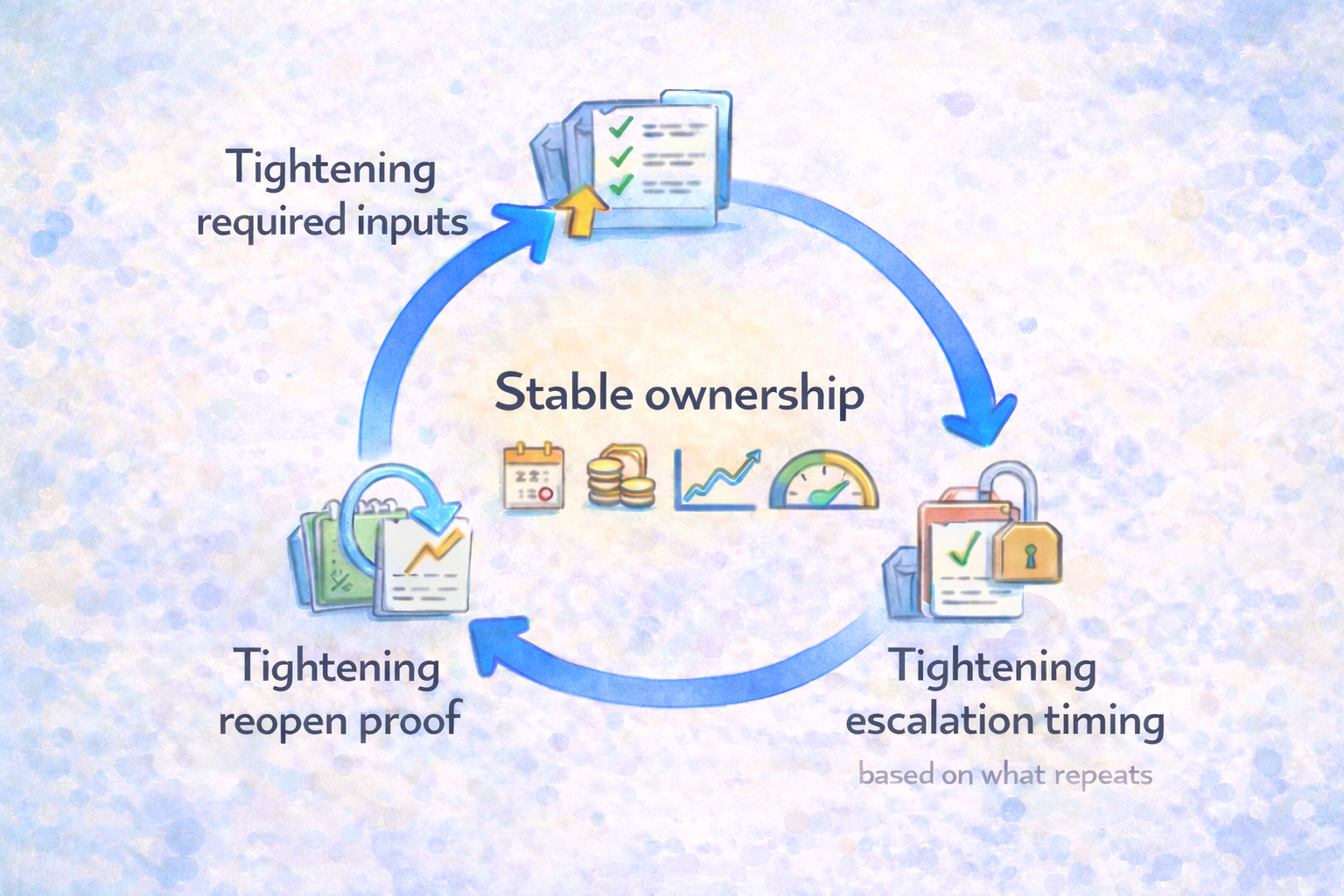
Decision rights work continues after seven days because week one installs basics. Teams expand the map only when repeats return and prove need. Teams tighten required inputs when owners drown in opinions. Teams tighten reversal proof when reopen attempts follow preference. Teams tighten escalation timing when leaders hear issues too late. A stable cadence turns week one into a lasting operating model.
Some decisions need a permanent home inside the management structure. Date decisions often need one accountable owner for a full quarter. Spend decisions often need one sponsor to reduce monthly renegotiation. Quality bar decisions need one definition owner and one record location. Consistent ownership reduces uncertainty because teams stop guessing authority. Stable ownership also reduces stakeholder lobbying because the process stays clear.
Weak decision systems show up even in well run organizations. Complexity grows faster than governance for many scaling teams. Decision time varies across teams and breaks planning and execution. Gallup reports low satisfaction with decision speed and decision quality. Low trust drives extra review layers and more stakeholder management. Extra layers increase meeting load and slow execution even more.
Extra review layers create a loop where process reduces confidence. Teams lean on influence and escalation because authority stays unclear. People hold back commitment because reversals feel random and undocumented. Decision rights reverse that pattern through owners, deadlines, and decision records. Teams spend less time lobbying and more time executing. Managers gain time because fewer decisions return as repeats.
Decision rights make the call clear and keep it stable for execution. Decision rights reduce rework because decisions stop wobbling midstream. Decision rights lower meeting load because owners can decide with time bound input. Decision rights improve delivery because the decision pipeline clears faster. Evidence driven reopen rules keep flexibility without reopening every week. The system rewards execution because authority and accountability stay explicit.
Cross functional speed improves when decision authority becomes explicit at key boundaries. Missing decision rights create loops that look like misalignment. Owners and deadlines and reversal proof and decision logs create closure. Execution results should speak and end debate in a visible way. Daily work feels lighter because teams stop paying the same decision tax. Teams ship more because decisions stop returning as unresolved topics.